Category Archives: hip-hop

I Used to Love H.E.R.: Dan Mennella (The Mennella Line)

The 50th installment of I Used to Love H.E.R., a series in which artists/bloggers/writers discuss their most essential or favorite hip-hop albums and songs, comes from NY-based writer Dan Mennella, a friend, former co-worker and fellow music/baseball devotee (see his info below).

Dan surprised me with this one, providing a compelling argument to revisit an album with which I’d (probably unfairly) spent little time.

the grind dateDe La Soul, The Grind Date
(Sanctuary Records, 2004)

It’s funny, in a way, that this great record became one of my favorites and a very important one to me. Prior to The Grind Date, I didn’t like De La Soul all that much. I didn’t have anything against them, but I was 21 in 2004, and their best, early work had not aged well at all.

That’s not a criticism unique to De La, of course, merely an observation about the genre as a whole. If you were to look at the changes in hip-hop over a 13-year stretch from 1991 to 2004 in contrast to those from, say, 1998 to 2011, that idea becomes more apparent.

Anyway, The Grind Date is the record that brought De La into the 21st Century. The aesthetic was essentially the same, but they were now delivering it in a way that spoke to me and a new generation of fans, in particular those who, like me, were supporters of a very credible and thriving underground with acts like MF Doom, Murs, Madlib, Little Brother, the Def Jux crew and so on.

That whole movement may seem sort of dated now, but a lot of the guys on this record – producers J. Dilla, Madlib, 9th Wonder, Supa Dave West and Jake One, and MCs Doom and Ghostface – were at their creative heights in 2004. And that, combined with De La’s new-found focus and sense of craftsmanship, makes for a great record. It’s cohesive and lean, whereas the older records were too long and skit-heavy for my liking.

On a personal note, what really resonated with me was the record’s overarching themes: manhood, maturity, and self-reliance, to name a few. I was in the thick of a tough personal time in ’04, and, as I said earlier, I was 21, in college, and on the verge of entering the real world, i.e. adulthood. Pos and Mase rap from a place of peace and wisdom after having gone through the music-industry wringer, and I greatly admired their resolve. It showed me that people could go through a lot and still come out OK on the other side.

It was little nuggets like this from Church that helped me fight through helplessness and despair: “Instead of giving you a share or serving you a dish / I’ll lead you to the water, show you how to fish.”

I think De La always touched their fans in that way, but for the people to whom 3 Feet or Stakes Is High sounded too old, De La was able to reach them with The Grind Date. And if you look at this series, it’s a testament to their prowess as smart and talented artists that they have records from distinct eras featured here.

Dan Mennella is a NY-based writer and editor. His work has appeared on MLB.com, MLB Trade Rumors, the Long Island Press and RapReviews.com. Check out his blog, where he writes about sports, music, politics and literature, or follow him on Twitter.

Chuck D: By the Time I Got to Arizona art piece

chuckd

Twenty years later and Chuck D has delivered another missive to the Arizona government. In a play off the 1991 protest anthem, By the Time I Get to Arizona – which decried the state’s refusal at the time to recognize a Martin Luther King Jr. holiday – the Public Enemy frontman has collaborated with Los Angeles’ SceneFour on a visual art piece, By the Time I Got to Arizona.

The limited-edition 60-by-33-inch piece – only 300 canvasses were produced, each numbered and signed by Chuck D – takes on Arizona’s strict SB 1070 immigration law, which has fueled outrage over racial profiling. The piece costs $500 (with four installment plans available).

Our friend Jeff Weiss talked to Chuck D. about the piece and politics for the Pop & Hiss blog at L.A. Times.

Says Chuck D: “Of course, it doesn’t mean that all the people in Arizona are like that, it’s just that people in governmental situations may have this manifest destiny with what they consider their territory. They’re the types who say that they’ve had family here for 500 years and want to spend billions of dollars on a wall. But it’s not just pointed at them, it’s pointed at those in Texas, New Mexico, California and Arizona who are against Brown people, Mexicans and Latinos.”

I Used to Love H.E.R.: Isaiah Toothtaker

toothtaker

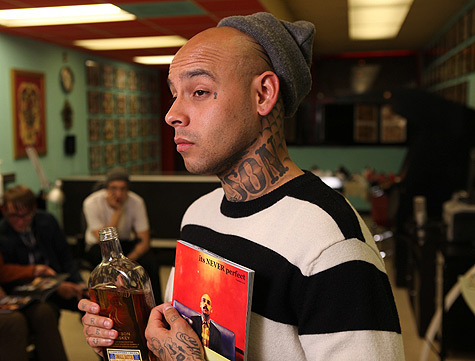
The 49th installment of I Used to Love H.E.R., a series in which artists/bloggers/writers discuss their most essential or favorite hip-hop albums and songs, comes from Tucson rapper/tattoo artist/convicted felon/all-around badass Isaiah Toothtaker, who in the past two years has become one of my favorite voices in hip-hop. That he’s from my home state – and reps it to the fullest – makes it all the better.

Toothtaker released Illuminati Thug Mafia – compelling as it is chilling – on Jan. 25 and is scheduled to perform at the Paid Dues festival on April 2 with his Machina Muerte crew. Read more on Toothtaker in a recent interview at Brute-iful.

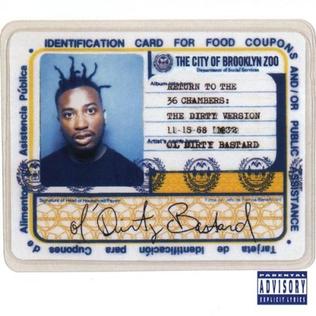
And if his impassioned words about Ol’ Dirty Bastard weren’t convincing enough, Toothtaker provided a photo of one of his tattoos to show his devotion (click to enlarge).

return to the 36 chambersOl’ Dirty Bastard, Return to the 36 Chambers (Elektra, 1995)
Fuck the dumb shit, it’s always Ol’ Dirty Bastard’s “Return to The 36 Chambers” top to bottom all day!

When I first heard “Return to the 36 Chambers” I was so amazed I played it front to back three times in a row and all else that was supposed to occupy my reality completely left me as I returned and returned and returned to the 36 chambers. The unpolished mixing and low fi audio quality added to the aesthetic and made the listening experience seem more exclusive, like I had acquired some rare recording not intended for public attention. Talk about dynamics: Here I was this lost youth with his obscure tape.

I was so mesmerized by the psycho babble of this genius I was more cult follower than fan. I worshiped the album thoroughly and examined every song till I wore the actual tape inside the cassette thin, mostly being stretched when batteries would run down or from constant rewinding. Man I studied this record, STUDIED, over and over…ahh yeah Wu-Tang again and again! ODB was actually dropping lessons, 5 percenter knowledge and street alchemy for one to decipher, I couldn’t fathom. A constant riddle that changed further every time my insight widened but that was the brilliance of the flux! At one instance the beats felt like they were dragging behind ODB’s drunken gibberish only to drift away in disharmonic crooning and at the next a song would enter with screams, threats and sharpened audio dialogue from movies that introduced sped up singing vocal samples. Through the insanity of it was all this talent that regulated a order of the wild, it refined the impossible without restricting it. ODB’s rapping took me to the point of questioning his ability into redirecting that to guessing my own comprehension of uninhibited delivery. “Return to the 36 Chambers” utterly challenged my whole shit, expectations, opinions, perspective, standards and eventually my own approach.

What was so futuristic to me then remains timeless to me now. RIP O’l Dirty Bastard.

Nocando, Curly Castro, Spit Suicide freestyle at Hidden House

Our show on Feb. 18 with Nocando, Open Mike Eagle and 5 O’Clock Shadowboxers turned out to be incredible. But the day wasn’t without its anxiety-filled moments, from Curly Castro’s lost luggage at the airport to Nocando, Open Mike Eagle and Jeff Weiss having to speed through the desert night after breaking free from L.A.’s traffic hell to make it to Hidden House right on time.

But all’s well that ends well. And each of the artists delivered performances that only proved why I thought this would be a special night when I started putting it together.

One of the best moments came when Open Mike Eagle set off a freestyle session with his song Go Home as the backdrop. It was about that time of the night when the alcohol was doing its job and the energy of the room was peaking. He invited any willing and able MCs to the stage, and Phoenix’s Spit Suicide rose to the challenge to join Nocando and Curly Castro of the Shadowboxers for a round. (Love watching OME having to wrest the microphone out of his hands.)

Nocando then did what he does best, flowin’ off the top of his head with ease while endearing himself to locals with a name-check of Yuma. But the loudest hollers might have come for Castro, who smashed the session with his closing eulogy to Seinfeld’s Uncle Leo.

Not to be outdone, Open Mike Eagle had to reset the song so he could rip a freestyle of his own:

5 O’Clock Shadowboxers: The Key Studio Sessions

shadowboxers_xpn

We are but one day away from a big night at the Hidden House with Nocando, Open Mike Eagle and 5 O’Clock Shadowboxers, and I couldn’t be more amped.

Speaking strictly as a fan, I can’t think of a lineup that better represents the hip-hop I’ve spent a majority of time listening to for the past year. And at the rate these guys move, 2011 will be an even bigger year. Nocando is working on a project with Busdriver (Flash Bang Grenada), a mixtape and a new full-length (check the interview at azcentral.com) and Open Mike Eagle is preparing to release his second full-length, Rappers Will Die of Natural Causes (he talked to the New Times).

And then there’s 5 O’Clock Shadowboxers, who are prepping a follow-up to The Slow Twilight in between solo projects from Zilla Rocca (Bad Weather Classic EP) and Curly Castro (Winston’s Appeal FTW), not to mention the collaborative Wu-Tang Pulp album.

They recently found time to drop by Philly NPR affiliate WXPN for an in-studio session for The Key, which should offer a good idea of what to expect on Friday.

Grab a couple of the tracks from the session below or download all right here.

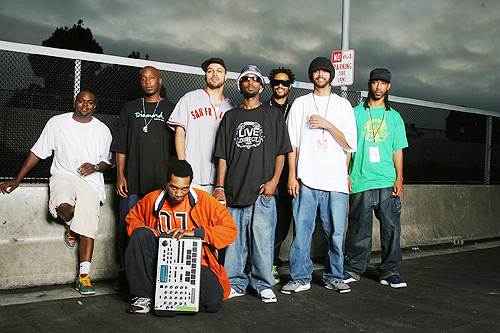
The stylish Philly duo of Zilla Rocca and Curly Castro present their music so hardboiled and sandpaper-rough it cuts to the bone.

Peep the Shadowboxers from their last performance at the Hidden House in September:

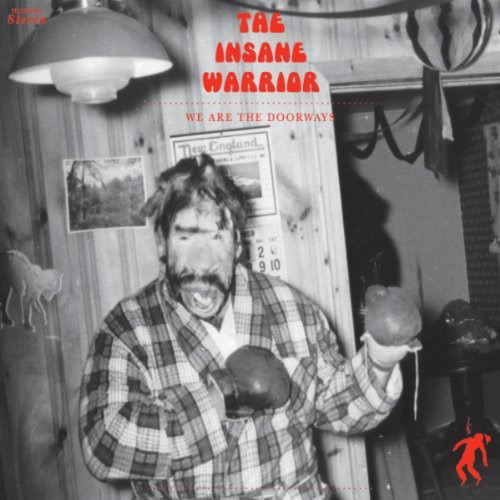
RJD2 as The Insane Warrior: We Are the Doorways

insanewarrior

Inspired by a spree of creativity (and a subscription to Netflix), RJD2 released a new album last week under the alias The Insane Warrior.

We Are the Doorways is a 10-track instrumental project that RJ cooked up as an ode to sci-fi/horror films circa 1975-1984. He doesn’t specify exactly which movies sparked this endeavor, but RJ does offer some insight into the process at his website:

“It was really like the perfect antidote to the mentality i take into an rjd2 record; alot of this music is in ways the exact opposite of what i am usually trying to do. (The content of alot of these movies can be really fascinating as well.) So i became obsessed with this stuff for a period, enough so that i ended up making a record that was in a lot of ways an homage to this era of film scoring. It allowed me to escape the baggage that can come along with the continuing of a catalog. And it was FUN. I had a blast making it.”

As you’d expect, RJD2 doles out a dose of hearty drum samples (like on Then You Hear Footsteps below), but he also alters the mood with spaced-out synths throughout. The second half of the eight-minute Black Nectar, which drifts off into a hypnotizing swirl of synths, probably best illustrates the sci-fi sound RJ is going for here.

Overall, it feels a little more tightly focused than the past couple albums under the RJD2 name. And he’s having some fun with it by holding a contest to ask for artistic submissions that complement any of the tracks from We Are the Doorways.

Also, check out the video for The Water Wheel that premiered last week on XLR8R:

RELATED:
RJD2 on Daytrotter
RJD2: A Spaceship for Now (video)
RJD2: Let There Be Horns (video)
New/old RJD2: Find You Out
I Used to Love H.E.R.: RJD2

Curly Castro: Eulogy to L

eulogytol

I can’t recall exactly which cassette I owned first – L.L. Cool J’s Bigger and Deffer or Run-DMC’s Tougher Than Leather – but both played huge roles in turning me on to hip-hop as a wee 9-year-old.

Like Radio before it, Bigger and Deffer blasted big boasts and gut-thumping beats. Hell, this album was too cool to have sides named A and B. No, they were called the “Bigger Side” and “Deffer Side,” naturally. I played that tape constantly, fascinated at the cadence of the beats and L.L.’s rhymes. Try not to get amped when L.L. flies in on I’m Bad: “No rapper can rap quite like I can / I’ll take a muscle-bound man and put his face in the sand.”

But we all know the L.L. that graced that cover – Kangol and rope chain, the definition of B.A.D. – isn’t the L.L. we know now. Zilla Rocca sums it up precisely: “Since 1997′s Phenomenon to present day, LL burned the goodwill of a thousand Kangols with each shallow and trendy album.”

And so it is that Curly Castro gives a voice to what we’ve all been thinking on his new single Eulogy to L, which is exactly what the title claims it is. Here lies James Todd Smith’s career: Rest in peace. It’s a bold callout – delivered over Zilla’s breakdown of The Boomin’ System – but one that gives the nostalgic among us a sense of closure.

The track will appear on Castro’s new LP Winston’s Appeal, which will be released on Friday through RocktheDub.com and Three Dollar Pistol Music. Stream it below or download at 33jones.com.

Castro will be performing as part of 5 O’Clock Shadowboxers (with Zilla Rocca) on Friday, Feb. 18, at the Hidden House with Open Mike Eagle and Nocando in a show I’m sponsoring with the guys at Universatile Music. You might remember him from the last time Shadowboxers rolled through town.

RELATED:
5 O’Clock Shadowboxers: Bottomfeeders (Small Pro Remix) + No Resolution, live in PHX
Curly Castro and Zilla Rocca: Str8 Westcoastin’ Mix
I Used to Love H.E.R.: Curly Castro

An ode to Hiero + new song Reputation

hiero

I Wish My Brother George Was Here, the 1991 debut album from Del the Funky (nee Funkee) Homosapien, wasn’t my introduction to Hieroglyphics, but it is, for all intents and purposes, the genesis for the Bay Area crew – a fact that’s being celebrated in Flagstaff on Jan. 22 in what’s being called a 20th anniversary show.

As much as I’d like to claim that I’d been there since the beginning, I came upon Hiero two years later, in 1993, through Souls of Mischief (as I assume many others did, too). I’d never heard of Souls when they opened for A Tribe Called Quest and De La Soul in December 1993 at the long-gone Roxy in Phoenix – and they weren’t even promoted on the ticket stub (one of many stubs/fliers I’ve kept) – but it didn’t take long before I had to have 93 ’til Infinity, an album I bought on cassette (yep, still have that, too). I was just an impressionable 16-year-old with a fresh driver’s license, probably oblivious at the time that I possessed a hip-hop classic.

That set off a level of fandom that, 18 years later, is almost hard to imagine. Souls shouted out the entire Hiero crew – and then some – on 93 ’til, and I did my damnedest to buy records by all of them. By fall of 1995, when I started college, I spent countless hours at Hiero Hoopla, the fan message board at Hiero’s website.

In some ways, I’m jealous of my 16-year-old self. Between Tribe and Hiero, I’m not sure I could ever invest in fandom like that again. Skepticism has replaced my youthful exuberance. I went to show after show, saved fliers, bought T-shirts, scribbled the Hiero logo all over.

But what I can truly appreciate about Hiero now, that maybe I didn’t fully grasp back in the day, is that they defined what it meant to be independent. After a falling-out with Elektra (Del) and Jive (Souls of Mischief and Casual), Hiero regrouped and, relying on their devoted fan base, founded Hiero Imperium, a record label that (in my mind) branded them as innovators. Remember, in 1995, record labels were far more of a necessity than they are today.

I interviewed Tajai of Souls of Mischief nearly three years ago, and this was his take on labels: “We signed a contract with the devil. They’re bankrolling your marketing and promotion to get you out there, so they feel like they can control the creative process. … They feel like they can invade your creative process under the guise of, ‘I have more experience and I know how it’s going to hit at radio.’ We’re lucky to have learned from it. It’s the best thing that happened to me (being on Jive) … We maybe didn’t get paid as much as we should have. But we’re getting 10 to 20 times more now. We’re finally seeing real money.”

And Hiero’s status has been further cemented as part of an art installation by When Art Imitates Life (W.A.I.L.) – Hiero: The Valley of Kings. To celebrate, the group released a new track, the aptly titled Reputation, which features A-Plus, Opio and Casual. Twenty years later, it’s a fitting reminder of Hiero’s place in hip-hop (and my own pantheon of artists).

Spirit Animal: Roman Holiday

spiritanimal

At some point – iTunes tells me it was possibly 2006 – I ended up with an mp3 of a track called Roman Holiday by the Gray Kid (aka Steve Cooper), who I guess must have sent it my way with detailed instructions to keep it under wraps. But when Gray Kid unleashed his damn near entire catalog for free download in early 2009, I assumed some tweaked/reworked/newer version of Roman Holiday would find its way to the masses. It was an airy song with an off-kilter rhythm that featured Gray Kid talking out verses and belting out choruses.

Alas, it was nowhere to be found – and for good reason. It was held back so it could be released on The Cost of Living, the debut LP from his synth-funk group Spirit Animal that was released, appropriately, on Election Day.

Says Gray Kid: “It was almost a Gray Kid song. But I left it off Free Music in ’09 at the last second and re-recorded the verses this year (2010) with all of the harmonies so they’d be more sung and less spoken. Then we added live drums, bass and some guitar – Jon Siebels from Eve 6 and Monsters Are Waiting who now runs Sonata Cantata played that. The original tracking was done four years ago.”

Now, after all that, you can finally get the track for free because Gray Kid, who recently relocated from L.A. to the East Coast, was cool enough to let me host it here.

RJD2 on Daytrotter

rjd2_daytrotterIt’s sort of impossible to quibble about anything the good folks at Daytrotter are doing – daily downloadable sessions from great bands, insightful writing and a free iPhone app with access to the site’s entire archive.

But if I had to nitpick, there’s just one thing I’d love to see more of at the site: sessions that feature more hip-hop and experimental beat-making artists. Daytrotter’s expansive history includes visits by Aesop Rock, Cadence Weapon and P.O.S., so a precedent has already been set.

And in a nice surprise on Monday, RJD2 added his name to the Daytrotter alum. A 13-minute mix by the Columbus, Ohio-bred sound collagist was recorded in October during Moogfest in Asheville, N.C., and made available as a free download. The best part? No singing! So head on over to Daytrotter to grab it.

In other (two-week-old) news, RJD2 released a free three-song EP for The Glow, a track off his latest album The Colossus. It features remixes from Flosstradamus, Candy Panther and Paolo Palazzo, whose reworking was selected by fans as the winner of a remix contest. The download also includes the video.